Browse our …
You've viewed …
You haven't yet viewed any products on our store. If you've been here before, you may need to sign in.
On Twitter …
Heather Tartan Large Notebook - Waverley Scotland Genuine Tartan Cloth Commonplace Notebook
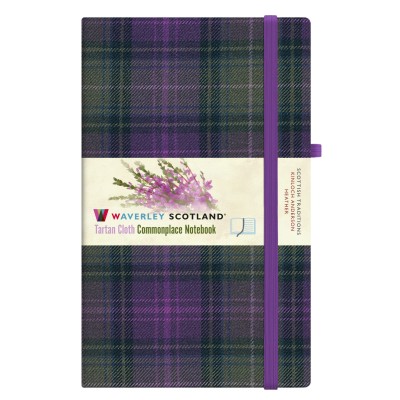
This large Waverley Heather tartan notebook (21cm x 13cm, with 192 pages, left hand page blank, right hand page ruled) is bound in authentic Heather tartan. With green and purple shades, the tartan represents the heather found growing in Scotland.
Published end of January 2026, this notebook part of the series of Tartan Notebooks celebrates Scottish Traditions – the many unique features of Scotland and its people. History, clans and tartans, the landscape of Scotland – hills, glens, mountains, lochs and rivers guarded by the many castles and strongholds of Scotland, some ancient and ruined, but each one full of history, with a story to tell.
Kinloch Anderson: The tartan cloth is supplied by and produced with the authority of Kinloch Anderson Scotland, holders of Royal Warrants of Appointment as Tailors and Kiltmakers to HM King Charles III.
Kinloch Anderson has created its own exclusive range of tartans which are available to all. They are based on the sett of the Clan Anderson tartan. The name Anderson means son of Andrew and Kinloch means head of the loch.
Commonplace notebooks date back to the Scottish Enlightenment. Many thinkers and writers used a Commonplace notebook for writing down ideas and knowledge. Adam Smith, Robert Burns, David Hume, and later, writers such as Sir Walter Scott, Arthur Conan Doyle, and Virginia Woolf used commonplace notebooks.
About the notebook: This notebook is made with cloth woven in mills in the United Kingdom. Notebook pages and paper components are made with acid-free paper from sustainable forests, and are EUDR Compliant. Boards used in the binding process are made of 100% recycled paper. This hardback notebook is bound in genuine British tartan cloth with an elastic closure, ribbon market, eight perforated end leaves and expandable inner note holder. It contains a removable booklet about the history of clan tartans, and a bookmark that gives information on the Hunting tartan.
192 pages.
Left side blank, right side ruled. Materials are EUDR Compliant.
Trimmed page size: 21 x 13 cm.
ISBN: 978-1-84934-608-5
Add another text field set
The Black Watch was formed in the wake of the unsuccessful 1715 Jacobite Rebellion, where James Francis Edward Stuart (1688–1766), son of the deposed James II, fought to put the exiled House of Stuart back on the throne.
From 1725, General George Wade (1673–1748) formed six military companies from the clans of the Campbells, Grants, Frasers and Munros. They were stationed in small detachments across the Highlands to prevent fighting among the clans, deter raiding, and to assist in enforcing laws against the carrying of weapons. In short, they were tasked with protecting the interests of the Hanoverian throne in Scotland.
Wade issued an order in May 1725, for the companies all to wear plaid of the same sort and colour. Their original uniform was made from a 12-yard long plaid of the tartan that we know now as the Black Watch tartan. They wore a scarlet jacket and waistcoat, with the tartan cloth worn over the left shoulder. The name is said to come from the dark tartan they wore, hence “black”, and from the fact that they were policing the land, hence “watch”.
The Black Watch museum states that the cloth would be wrapped around both shoulders and firelock (a musket type of gun) in rainy weather, and served as a blanket at night.
The Black Watch saw action in the French wars (1745–1815); battles of the Empire (Crimea, Indian Mutiny, Egypt, Sudan, Boer War); First World War; Second World War; and (post Second World War) saw action in Korea; carried out peace-keeping duties in Kenya, Cyprus and the Balkans; and took part in the invasion of Iraq (2003–4). Since 2006, the Black Watch has been the 3rd Battalion of the Royal Regiment of Scotland.
About the notebook: This notebook is made with cloth woven in mills in the United Kingdom. Notebook pages and paper components are made with acid-free paper from sustainable forests. Boards used in the binding process are made of 100% recycled paper. This hardback notebook is bound in genuine British tartan cloth with an elastic closure, ribbon market, eight perforated end leaves and expandable inner note holder. It contains a removable booklet about the history of clan tartans, and a bookmark that gives information on the Black Watch tartan.
192 pages.
Left side blank, right side ruled.
Trimmed page size: 21 × 13 cm.
ISBN: 978-1-84934-608-5
Kinloch Anderson: The tartan cloth is supplied by and produced with the authority of Kinloch Anderson Scotland, holders of Royal Warrants of Appointment as Tailors and Kiltmakers to members of th
