Browse our …
You've viewed …
You haven't yet viewed any products on our store. If you've been here before, you may need to sign in.
On Twitter …
The Waverley Gazette
The Haggis Mystery
The poem which we know as ’Address to a Haggis’ was written in 1786 - one of Burns's most famous and regularly performed poems.
Researching ‘AN OLD FARMER'S NEW YEAR'S MORNING SALUTATION’ we were distracted by a reference to the ‘Address to a Haggis’ which entitled it: ‘An Address To A Scotch Haggis on New Year’s Day’.
In 1806, it was part of a chapbook pamphlet published by Charles Randall, Stirling, with the title ‘An Address To A Scotch Haggis on New Year’s Day’, as a ‘filler’ supporting ‘The Auld Farmer’s Salutation To His Auld Mare Maggy’.
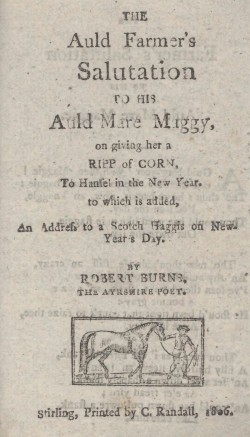
Burns didn’t call it ‘An Address To A Scotch Haggis on New Year’s Day’.
Where did that come from?
There are various stories linked to the writing of 'Address To A Haggis’.
• The first found, was contained in a caption relating to an engraving:
Archibald Prentice of Covington Mains, near Lanark, farmer, and friend of the Poet, known as "The Gudeman o' the Mains."
Mr. Prentice subscribed for 20 copies of the Edinburgh edition of the poems.
Burns, when on his way to Edinburgh in 1778, stayed overnight with Prentice. A sheet hoisted on a stack in the yard was the signal of the Poet's arrival, and all the neighbours assembled. To them, at supper time, the Poet recited the ‘Address to a Haggis’, composed for the occasion.
• Other accounts of the evening at Covington Mains make no mention of ‘Address to a Haggis’ but do however recount a telling of the ’Jolly Beggars’.
‘Robert Burns, in his itinerary to Edinburgh (per Mr Thomas Somerville LLD, nephew of Archibald Prentice) spent a night at the farmhouse of Mr Prentice, Covington Mains, near Carnwath. Archibald Prentice informed his brother farmers that Burns was expected at the Mains and a white sheet hoisted on a cornstack was to be a notice of his arrival and for all to assemble. Rev Briye Little, minister of the parish, Lang the schoolmaster and his brother the minister of Leadhills were present. Burns’s wonderful conversational powers drawn out by intelligent gentlemen and congenial friends carried all by storm. Songs and recitations, now grave, now gay, melted and cheered them by turns. In their excitement Burns said he would give the best yet after Mrs Prentice had left the room. She told him to go on – she would not leave the room that night. Burns then said, “Here is for the ‘Jolly Beggars’ (which was not published till after his death). Next morning accompanied by Prentice and the two Lang brothers, Burns breakfasted at Mr John Stoddart’s bank. On the way Mr Lang, of Leadhills asked Burns for a repetition of the ‘Jolly Beggars’. He replied ‘Na, na, Mr Lang, the inspiration is gone.’
• The Edinburgh Literary Journal, 1829 : “About 16 years ago, there resided at Mauchline, a Mr Robert Morrison, cabinet-maker. He was a great crony of Burns and it was in Mr Morrison's house that the poet usually spent the ‘mids o’ the day’ on Sunday. It was in this house that he wrote his celebrated ‘Address To A Haggis’ after partaking liberally of that dish, as prepared by Mrs Morrison.
• According to Robert Chambers, Hogg, the Ettrick Shepherd has, on the contrary, averred that the poem was written in the house of Mr Andrew Bruce of Castle Hill, Edinburgh after in like manner partaking of the dish, but declares that it was first published in the Scots Magazine for January 1787. It was indeed published then, but it was actually first published on Tuesday December 19th 1786 when the poem appeared in The Caledonian Mercury with the heading :
FOR THE CALEDONIAN MERCURY
ADDRESS TO A HAGGICE.
BY R. BURNS
[NEVER BEFORE PUBLISHED]
But there’s a difference to the last verse that we are familiar with.
The Caledonian Mercury has, as the last verse :
Ye
Pow’rs wha gie us a’ that’s gude,
Still
bless auld Caledonia’s brood
Wi’
great John Barleycorn’s heart’s blude
In
strowps or luggies;
And
on our board that king o’ food,
A
glorious Haggice!
The last verse – as we know today is :
Ye Pow’rs wha mak mankind your care,
And dish them out their bill o’ fare,
Auld Scotland wants nae skinking ware
That jaups in luggies;
But, if ye wish her gratefu’ prayer,
Gie her a Haggis!
• The Life & Works of Robert Burns, 1852, edited by Robert Chambers, features the original last verse as an impromptu Grace given by Burns :
EXTEMPORANEOUS GRACE ON A HAGGIS
It has been stated, that being present at a party where a haggis formed part of the entertainment, and being asked to say something appropriate on the occasion, Bums produced this stanza by way of grace; which being well received, he was induced to expand it into the poem entitled ‘To a Haggis’, retaining the verse in an altered form as a peroration. [The concluding part of a speech, typically intended to inspire enthusiasm in the audience.]
Robert Crawford’s The Bard, in which Crawford states “The best new poem Burns added (to the Edinburgh Edition) was ‘To a Haggis’. Perhaps composed in Mauchline for a ‘Haggis Club’ harvest supper in 1785 (as John Richmond claimed) the poem was certainly ready in time for 19 December’s Caledonian Mercury – a ‘taster’ for his second edition.
It seems unlikely that Burns composed a poem of 48 lines with 267 words ‘there and then’ at dinner on Castle Hill.
Perhaps it began at Mauchline, in Mr Morrison's house, and Robert Burns worked away at it and was perhaps able to perform it at Castle Hill – from memory.
Available from Waverley Books :
 RSS
